The notation guide covers the symbols themselves; this one is about turning those symbols into something your hands can play without stopping to think.
Fluent reading starts before your fingers move. You look one group ahead, find where it ends (a chord, a bar, a timing slot), and give your hands a small plan instead of leaving them to react to each letter as it shows up on screen.
Practice-range handoff
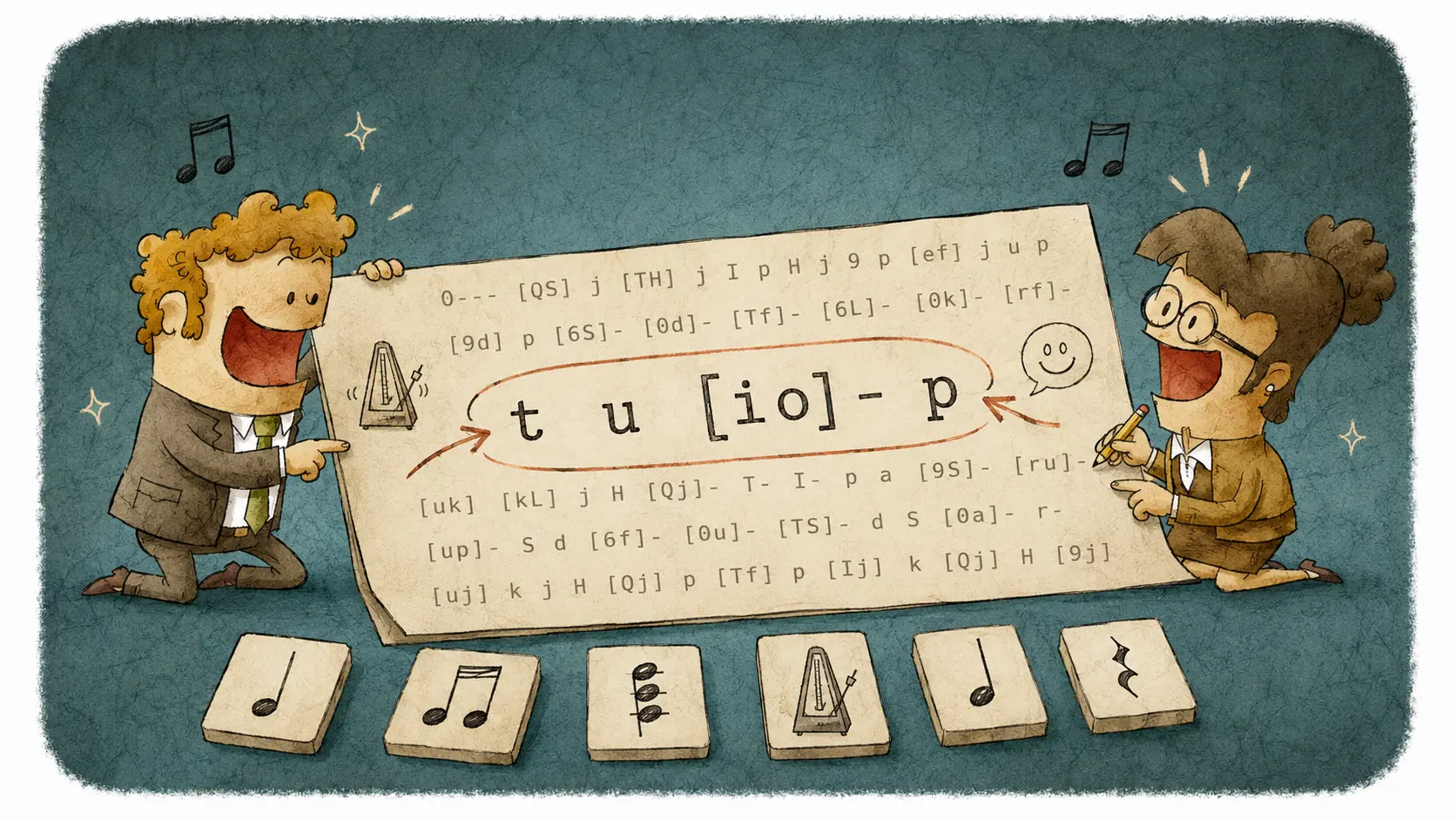
One example, worked through completely
- Say the event types out loud: note, note, chord, timing slot, note.
- Play `t u [io]` as one group, slowly, without stopping before the chord.
- Add the timing slot and the final `p`, keeping your eyes one event ahead of your hands.
- Repeat the full group three times, then try the same method on a real sheet.
A common mistake: reading letter by letter
The most common thing that breaks a beginner's rhythm isn't a hard chord. It's treating every letter as its own decision, the same way you'd sound out unfamiliar words one syllable at a time.
You can usually hear this happening: a tiny hitch before every chord, a rushed final note, no real sense of where one phrase ends and the next begins.
It happens because your eyes are tracking one character instead of scanning ahead to the next chord or bar. The fix isn't to play faster. Before you press the first key in a group, find where that group ends, then treat everything before it as one unit rather than a string of separate presses.
Breaking a longer sheet into segments
A full sheet is just more of the same groups back to back, but that can feel like a wall of text if you try to read it all at once. Mark it into short segments instead, something you can get through in five to ten seconds each.
Practice one segment until you can look slightly ahead while your hands are still finishing it. Then overlap the two: play the last event of one segment together with the first event of the next, instead of stopping cleanly between them. That overlap is what removes the pause at each boundary. Without it, every segment ends up sounding like its own separate performance.
Loop one selected passage
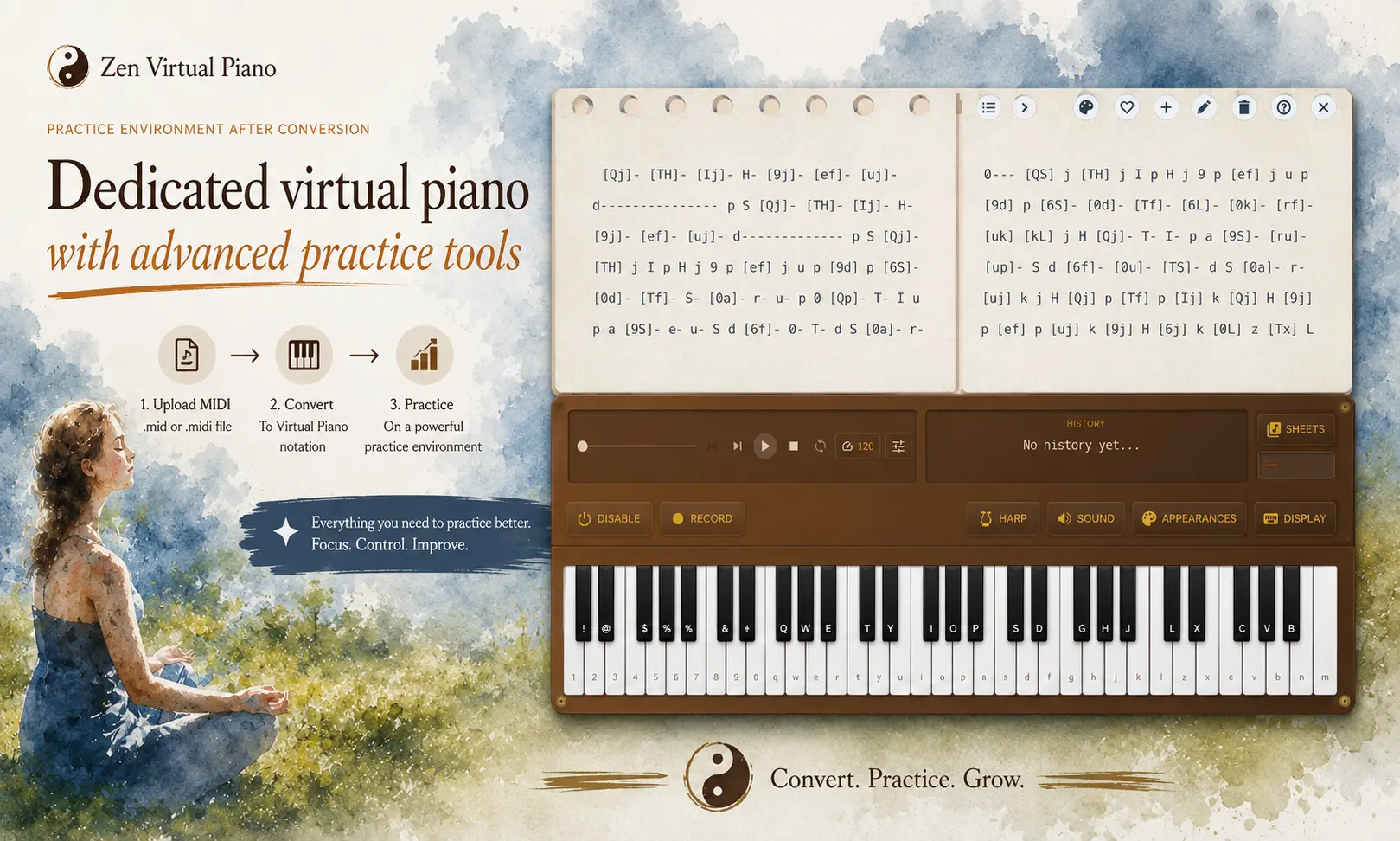
Open a current sheet in Zen Virtual Piano, select only the short passage you marked, and enable Loop. Lower the tempo if the boundary is still uneven. Each repeat should return to the selected passage, letting you watch for the same two signals: a pause before the chord or a rushed event after the timing slot.
A short practice routine
| Time | Do this |
|---|---|
| 0:00–0:30 | Scan the sheet and mark where each group ends: chord, bar, or timing slot |
| 0:30–1:30 | Play each group slowly. Pausing between groups is fine here |
| 1:30–2:30 | Remove the pauses. Overlap the last event of one group with the first of the next |
| 2:30–3:00 | Play the whole sheet at tempo, start to finish, no stopping |
The three-minute schedule above is optional: use it to plan one short practice pass.
Practice now
Pick something short in the Library so you're practicing grouping and look-ahead rather than fighting through a long song. Read it once slowly, mark one passage, then use the selected-passage loop and optional three-minute routine. If the seam still breaks, confirm where the group starts and ends before changing tempo. The article's primary action opens Zen Virtual Piano for that practice pass.
Practice now destinations