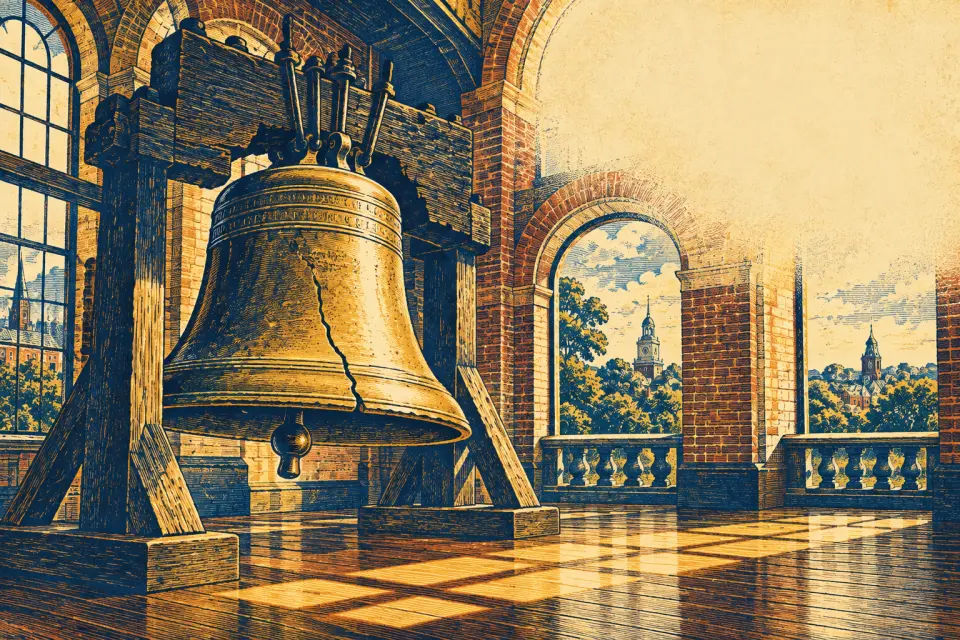
The Liberty Bell
John Philip Sousa
Song library
Browse piano sheets by John Philip Sousa on Zen Virtual Piano. John Philip Sousa was a composer, bandleader and conductor who grew up in Washington, D.C., the son of an immigrant Portuguese father and a German mother. Violin came first, from age six, with various band instruments added later. His harmony and music theory teachers were John Esputa and, after him, George Felix Benkert. To keep the boy from joining a circus band, his father, who played trombone in the Marine Band, signed him up at 13 as an apprentice in the United States Marine Corps. A trombonist father in the Marine Band, beside his son's training on violin, may suggest a household where band music was close at hand. In 1875 Sousa departed the band. The five years that followed saw him working as a violinist while he picked up conducting. In 1880 he came back to the Marine Band as its head. He conducted it until 1892, and during those years it developed into the country's premier military band. The year he left the Marine Band, he organized The Sousa Band. Between 1892 and 1931 it gave 15,623 concerts at home and abroad, the Royal Albert Hall in London among the venues. Five years as a violinist who learned to conduct, beside a band touring for decades, may point to conducting as the center of his working life. Among Sousa's marches are Semper Fidelis (1888), The Washington Post (1889), The Liberty Bell (1893) and The Stars and Stripes Forever (1897). In Chicago, at a spectacle called America, a backdrop bearing a huge painting of the Liberty Bell came down while Sousa was there with George Frederick Hinton, one of the band's managers. Hinton proposed The Liberty Bell as the title. Among Sousa's earliest marches sold to the John Church Company, it also became the first of his compositions to earn him real money. Structurally the march uses an "extended" trio form, a layout that military marches have treated as standard ever since. Tubular bells in the trio stand for the ringing of the Liberty Bell. A Chicago backdrop, beside tubular bells in the trio, may link the march's title to the sound of its music. A march that brought his first substantial reward, beside a form that has since become standard, may hint at the weight The Liberty Bell carries in his work. At the Waldorf-Astoria Hotel on October 6, 1925, Sousa heard a demonstration of the Orthophonic Victrola and said, "Gentlemen, that is a band." For him it was the first mechanical talking machine to produce music with soul. Sousa ranked as one of the all-time great trapshooters and organized the first national trapshooting organization. He also wrote three novels and an autobiography, Marching Along (1928). A trapshooting organization, beside three novels and an autobiography, may hint at activities that went beyond the podium. A Victrola remark about soul, beside his own band work, may show how closely he listened to live music.
Browse piano sheets by John Philip Sousa on Zen Virtual Piano.
John Philip Sousa was a composer, bandleader and conductor who grew up in Washington, D.C., the son of an immigrant Portuguese father and a German mother. Violin came first, from age six, with various band instruments added later. His harmony and music theory teachers were John Esputa and, after him, George Felix Benkert. To keep the boy from joining a circus band, his father, who played trombone in the Marine Band, signed him up at 13 as an apprentice in the United States Marine Corps. A trombonist father in the Marine Band, beside his son's training on violin, may suggest a household where band music was close at hand.
In 1875 Sousa departed the band. The five years that followed saw him working as a violinist while he picked up conducting. In 1880 he came back to the Marine Band as its head. He conducted it until 1892, and during those years it developed into the country's premier military band. The year he left the Marine Band, he organized The Sousa Band. Between 1892 and 1931 it gave 15,623 concerts at home and abroad, the Royal Albert Hall in London among the venues. Five years as a violinist who learned to conduct, beside a band touring for decades, may point to conducting as the center of his working life.
Among Sousa's marches are Semper Fidelis (1888), The Washington Post (1889), The Liberty Bell (1893) and The Stars and Stripes Forever (1897). In Chicago, at a spectacle called America, a backdrop bearing a huge painting of the Liberty Bell came down while Sousa was there with George Frederick Hinton, one of the band's managers. Hinton proposed The Liberty Bell as the title. Among Sousa's earliest marches sold to the John Church Company, it also became the first of his compositions to earn him real money. Structurally the march uses an "extended" trio form, a layout that military marches have treated as standard ever since. Tubular bells in the trio stand for the ringing of the Liberty Bell. A Chicago backdrop, beside tubular bells in the trio, may link the march's title to the sound of its music. A march that brought his first substantial reward, beside a form that has since become standard, may hint at the weight The Liberty Bell carries in his work.
At the Waldorf-Astoria Hotel on October 6, 1925, Sousa heard a demonstration of the Orthophonic Victrola and said, "Gentlemen, that is a band." For him it was the first mechanical talking machine to produce music with soul. Sousa ranked as one of the all-time great trapshooters and organized the first national trapshooting organization. He also wrote three novels and an autobiography, Marching Along (1928). A trapshooting organization, beside three novels and an autobiography, may hint at activities that went beyond the podium. A Victrola remark about soul, beside his own band work, may show how closely he listened to live music.
Search the library
John Philip Sousa
John Philip Sousa
Common questions
John Philip Sousa was a composer, bandleader and conductor who grew up in Washington, D.C., and led the Marine Band from 1880 to 1892.
Sousa left the Marine Band in 1892 and organized The Sousa Band that year. Until 1931 the band toured and played 15,623 concerts.
In Chicago a backdrop with a huge painting of the Liberty Bell was lowered, and Hinton, one of the band's managers who was there with Sousa, suggested the title for Sousa's new march.
Sousa wrote three novels, an instruction book for trumpet and drum, and an autobiography, Marching Along, published in 1928.