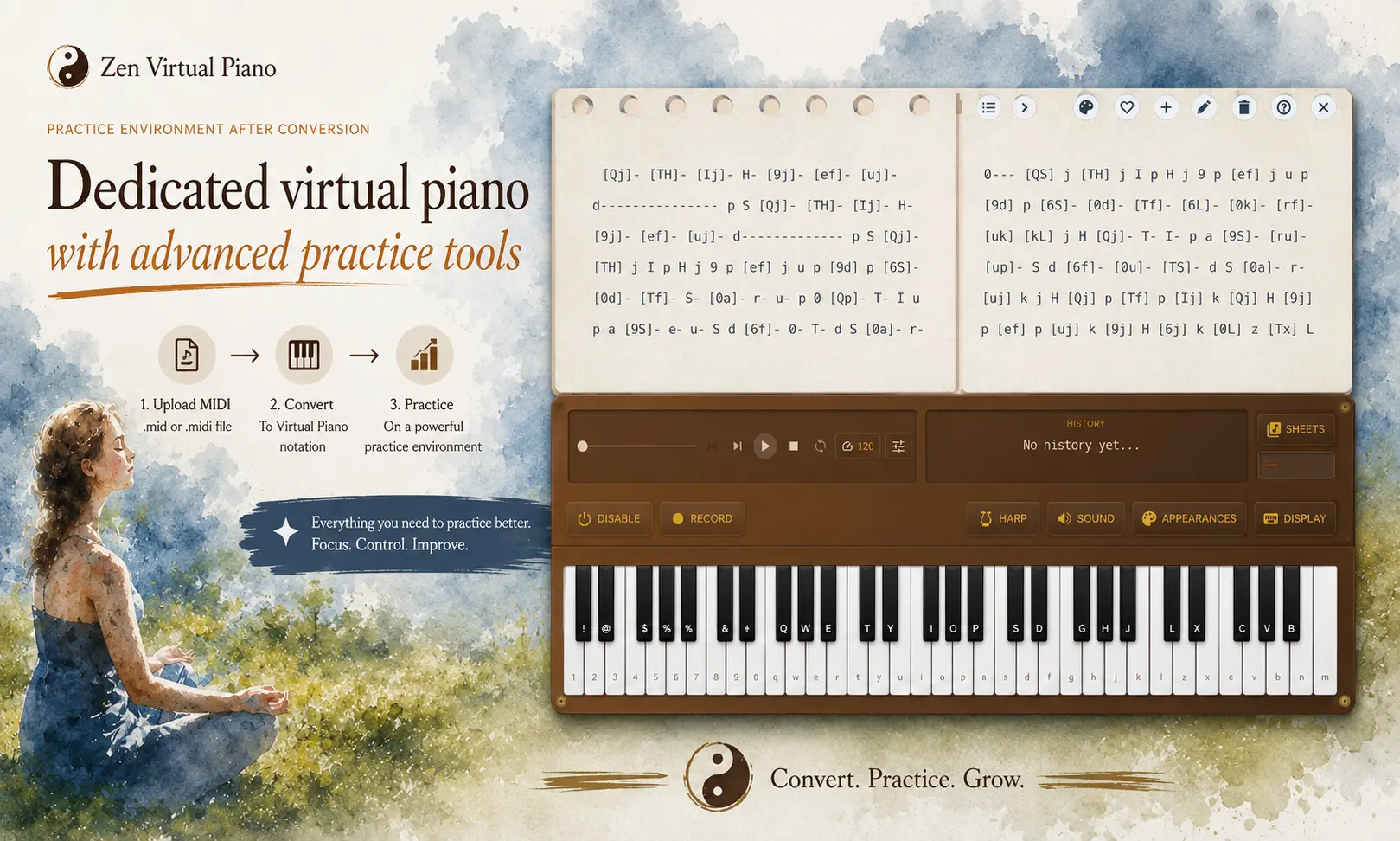
Keep the input and checkpoint fixed long enough to hear what changed. If a run breaks, return to the selected passage instead of restarting the whole sheet. This turns a vague “play it again” session into an exercise with an observable result: the same short passage lands correctly and evenly several times.
What you need before starting
- Basic keyboard-to-note mapping — use Key Assist or the notation guide if you have not read a sheet before.
- The Zen Virtual Piano metronome set slowly enough that each note can land evenly.
- One short selected passage from a sheet you are allowed to practice.
If you already read sheet music or have piano background, skip to Alternative method below — the three-checkpoint drill is built for people decoding notation for the first time.
Notation guide
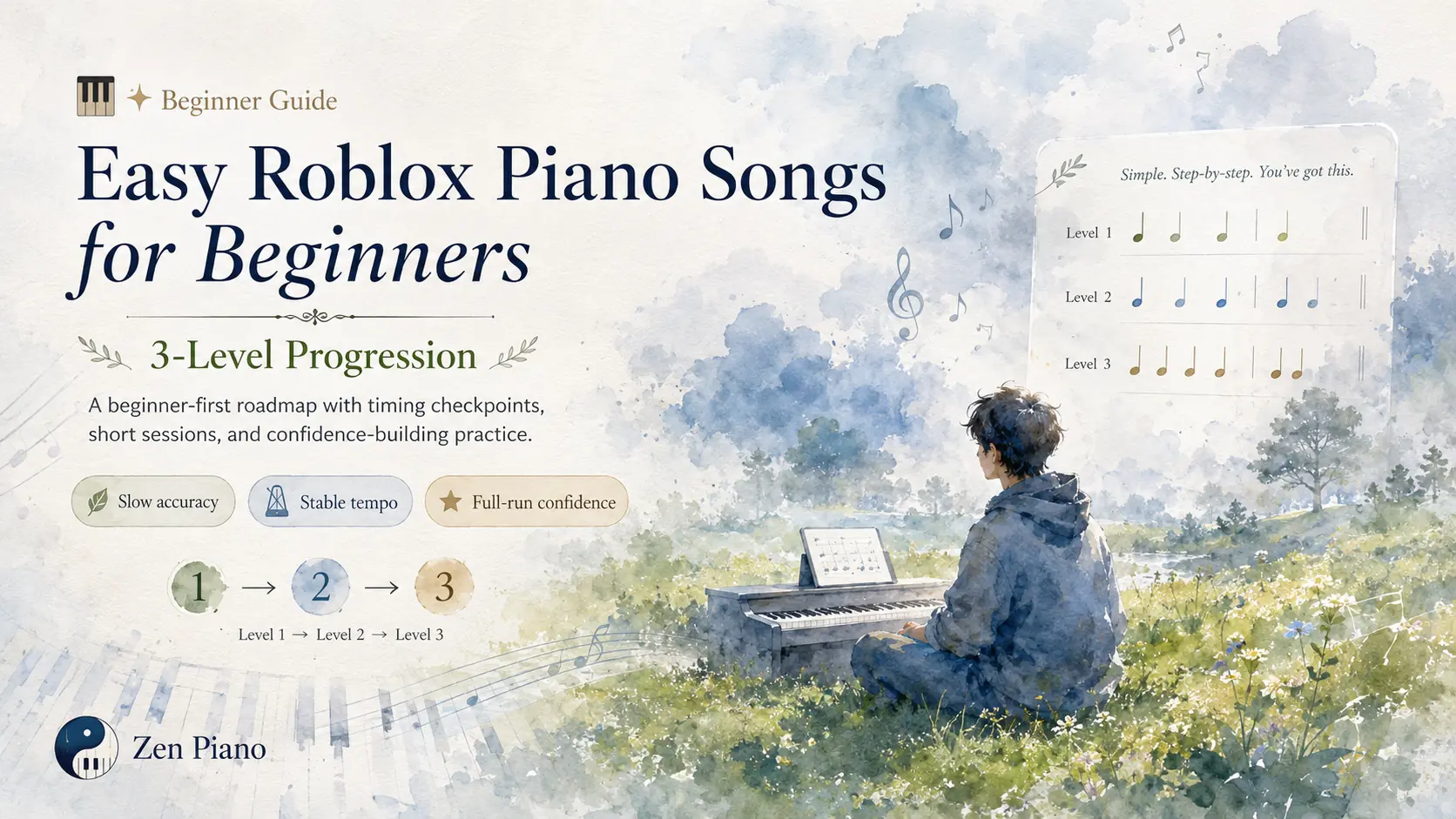
Optional method — three checkpoints in about 15 minutes
Use the times as planning limits for one passage. If a checkpoint is not met when its time box ends, keep the same passage for the next session rather than treating elapsed time as proof of progress.
Checkpoint 1: Slow accuracy — 5 minutes
Goal: every note in the selected passage lands correctly at a deliberately slow tempo.
Play the first phrase (4–8 notes) at roughly half your eventual target tempo. Stop the instant a note is wrong — don't play through it. Restart the phrase from the beginning, not from the mistake.
Checkpoint 2: Stable tempo — 5 minutes
Goal: the same phrase at real speed, evenly spaced.
Keep the selected passage exactly the same as Checkpoint 1 and raise the metronome by one step. Change tempo or passage length per round, never both; otherwise you cannot tell which change introduced the mistake.
Checkpoint 3: Full-run confidence — 5 minutes
Goal: play the whole song once, start to finish, without stopping.
Play the complete song at your working tempo. If you hesitate or miss a note, keep going — don't restart mid-run. Note where the hesitation happened; that transition becomes the start of your next Checkpoint 1.
Practice example
| Element | What it means | What to listen for |
|---|---|---|
| Repeated 3–4 note group | The same short pattern plays more than once in the song | Each repeat should sound identical in timing |
| Narrow key range | Notes stay close together on the keyboard | Minimal hand movement between notes |
| No stacked chords early on | Notes play one at a time, not simultaneously | A clean, single attack per note |
| One tempo change point | The song doesn't speed up or slow down mid-phrase | Even spacing until the marked change |
Sheets with these four traits are what "beginner-friendly" actually means — not shortness alone.
Choose a beginner passage by observable traits
Choose a passage with a repeated three- or four-note group, a narrow key range, few or no stacked chords, and one steady pulse. Those traits are more useful than a song title or video difficulty label because you can inspect them in the sheet before practice.
Common mistake
Playing the full song at target tempo on the very first attempt, resetting from the beginning every time a note is missed.
Why it happens
It feels faster to "just try the whole thing" than to isolate a short phrase. But every reset from bar one means the easy opening notes get over-practiced while the actual problem transition never gets isolated — so the same mistake repeats session after session.
Fix
When a run breaks, don't go back to the start. Isolate just the phrase around the break, run it through Checkpoint 1 and 2 again, then rejoin it to the section before it.
Pass checkpoint
Before moving to a harder song, confirm all three:
- You can complete a full run with no more than one hesitation.
- You can name where that hesitation happens.
- You can still play the song cleanly a week later without re-drilling it from scratch.
Alternative method — when to use it
If the key mapping is already automatic, begin with the stable-tempo checkpoint. Return to slow accuracy whenever the selected passage produces a wrong note; experience does not make that diagnostic step unnecessary.
Optional five-minute planning routine
| Time | Activity |
|---|---|
| 0:00–1:30 | Slow run of the current problem phrase (Checkpoint 1) |
| 1:30–3:00 | Same phrase at working tempo (Checkpoint 2) |
| 3:00–4:15 | Full song run, note where it breaks (Checkpoint 3) |
| 4:15–5:00 | Record or listen back to one pass and name the next passage to isolate |