 Classical0:30
Explore 1 folha
Ordenar:
Biblioteca de músicas
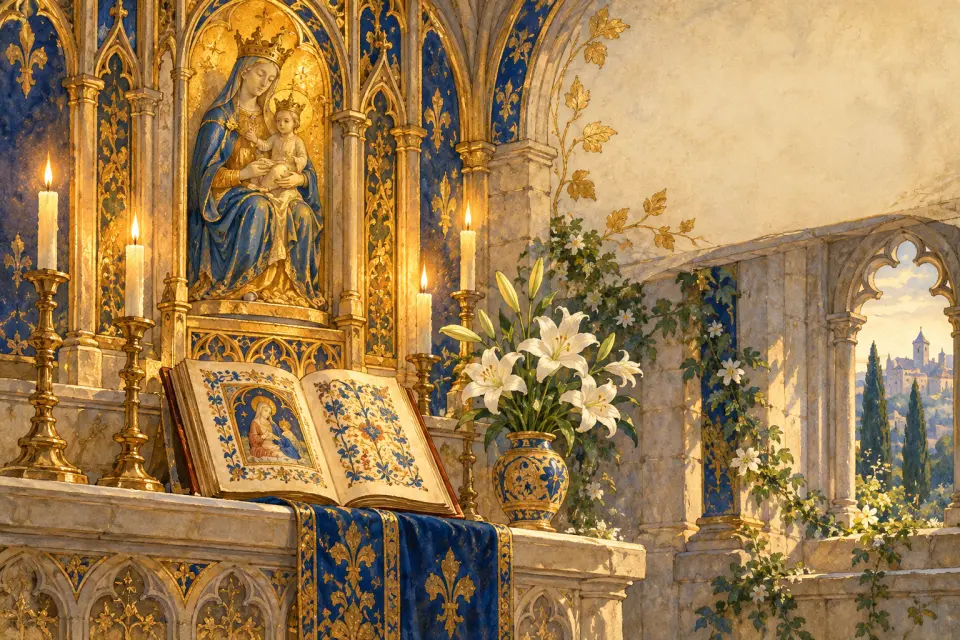
Explore folhas de piano de Alfonso El Sabio no Zen Virtual Piano. Of the 420 poems in the Cantigas de Santa Maria, 356 are narratives of Marian miracles; apart from an introduction and two prologues, the others are songs of praise or concern Marian festivities. The metrics are extraordinarily diverse, with 280 different formats for the 420 Cantigas. A set with 280 formats among 420 poems suggests a collection where variety was the rule rather than the exception. The Cantigas have long been credited to Alfonso as a whole, yet later scholarship has shown that most were the work of the musicians and poets around him, and only a few are his. The codices are generally thought to have been made in his lifetime, one perhaps in the 1270s and others in the early 1280s, up to his death in 1284. A traditional credit to Alfonso beside a court of poets and musicians gives the work two kinds of author, one named and one collective. At sixteen Alfonso began a soldier's career serving under his father. From the start of his reign his court employed Jewish, Christian and Muslim scholars, chiefly to translate Arabic and Hebrew books into Latin and Castilian, and he always insisted on overseeing the translations himself. His court compiled a work in Castilian titled General Estoria. A soldier at sixteen who later insisted on supervising translations shows two kinds of command, one over troops and one over texts. Alfonso preferred to leave the throne to his grandsons, but Sancho had the support of the nobility. A preference for his grandsons set against the nobility's support for Sancho leaves a thread of unfinished business at the close.
Explore folhas de piano de Alfonso El Sabio no Zen Virtual Piano.
Of the 420 poems in the Cantigas de Santa Maria, 356 are narratives of Marian miracles; apart from an introduction and two prologues, the others are songs of praise or concern Marian festivities. The metrics are extraordinarily diverse, with 280 different formats for the 420 Cantigas. A set with 280 formats among 420 poems suggests a collection where variety was the rule rather than the exception.
The Cantigas have long been credited to Alfonso as a whole, yet later scholarship has shown that most were the work of the musicians and poets around him, and only a few are his. The codices are generally thought to have been made in his lifetime, one perhaps in the 1270s and others in the early 1280s, up to his death in 1284. A traditional credit to Alfonso beside a court of poets and musicians gives the work two kinds of author, one named and one collective.
At sixteen Alfonso began a soldier's career serving under his father. From the start of his reign his court employed Jewish, Christian and Muslim scholars, chiefly to translate Arabic and Hebrew books into Latin and Castilian, and he always insisted on overseeing the translations himself. His court compiled a work in Castilian titled General Estoria. A soldier at sixteen who later insisted on supervising translations shows two kinds of command, one over troops and one over texts.
Alfonso preferred to leave the throne to his grandsons, but Sancho had the support of the nobility. A preference for his grandsons set against the nobility's support for Sancho leaves a thread of unfinished business at the close.
Pesquisar na biblioteca