 Classical1:38
Explora 1 partitura
Ordenar:
Biblioteca de canciones
Explora partituras de piano de Jacob Arcadelt en Zen Virtual Piano. His early life is poorly documented; the varying spellings of his surname point to Flemish roots somewhere around Liège or Namur, yet he appears to have grown up in France. Sometime in the late 1520s he seems to have crossed into Italy and taken a place in the household of Duke Alessandro de' Medici in Florence. His first book came from the Venetian printer Antonio Gardano in 1538, but no copy survives; a Milan edition of 1539, apparently pirated, carried settings of poems by Petrarch, Sannazaro, Bembo and others. A printed book that has vanished and a pirated one that survives suggest how much of his early reputation rests on copies made by other hands, and why a composer's early years can be so hard to reconstruct. In 1538 he moved to Rome on his appointment to the papal choir at St Peter's Basilica, joined the Giulian chapel, and a year later the Sistine Chapel. In 1539 he taught the boys at St Peter's as their singing-master, and in 1540 the college of papal singers admitted him. In the same period four books of his madrigals were published, and he met Michelangelo and set two of his sonnets to music. A papal singer who set Michelangelo's verse places his music within the circles of Rome's artists and clerics, which may help explain how his name became known beyond the choir. Giovanni Guidiccioni, another poet he set, supplied the words of his best-known piece, the four-voice madrigal Il bianco e dolce cigno (The white and gentle swan), which proved one of the sixteenth century's most lasting works. The piece opened one of Gardano's books and, already famous, was its main selling point. His madrigals are tuneful and plain in structure, singable, with a clear and generally fully diatonic harmony; unlike later madrigalists, he did not count on professional singers alone as his audience, for anyone able to read notes could sing them. Music meant for anyone who could read notes suggests an aim of sharing the madrigal with amateurs and not only with experts, which could help account for why this piece spread so widely. His 1557 book of masses carries a dedication to Charles de Guise, Cardinal of Lorraine, his new employer, for whom he worked as maître de chapelle, or choirmaster. Paul III's death in 1549 left him in search of a post; he recalled the Cardinal's invitation and joined his household in 1551 or 1552, and from then on he gave more attention to the chanson. In the preface to Le Roy and Ballard's Livre de meslanges of 1560, the poet Pierre de Ronsard called Arcadelt "the most illustrious composer of the day, his music equaled that of the ancients through the inspiration afforded by his Apollo." A move from Rome to a cardinal's court in France and a poet's praise in print suggest a reputation that crossed borders in his own lifetime.
Explora partituras de piano de Jacob Arcadelt en Zen Virtual Piano.
His early life is poorly documented; the varying spellings of his surname point to Flemish roots somewhere around Liège or Namur, yet he appears to have grown up in France. Sometime in the late 1520s he seems to have crossed into Italy and taken a place in the household of Duke Alessandro de' Medici in Florence. His first book came from the Venetian printer Antonio Gardano in 1538, but no copy survives; a Milan edition of 1539, apparently pirated, carried settings of poems by Petrarch, Sannazaro, Bembo and others. A printed book that has vanished and a pirated one that survives suggest how much of his early reputation rests on copies made by other hands, and why a composer's early years can be so hard to reconstruct.
In 1538 he moved to Rome on his appointment to the papal choir at St Peter's Basilica, joined the Giulian chapel, and a year later the Sistine Chapel. In 1539 he taught the boys at St Peter's as their singing-master, and in 1540 the college of papal singers admitted him. In the same period four books of his madrigals were published, and he met Michelangelo and set two of his sonnets to music. A papal singer who set Michelangelo's verse places his music within the circles of Rome's artists and clerics, which may help explain how his name became known beyond the choir.
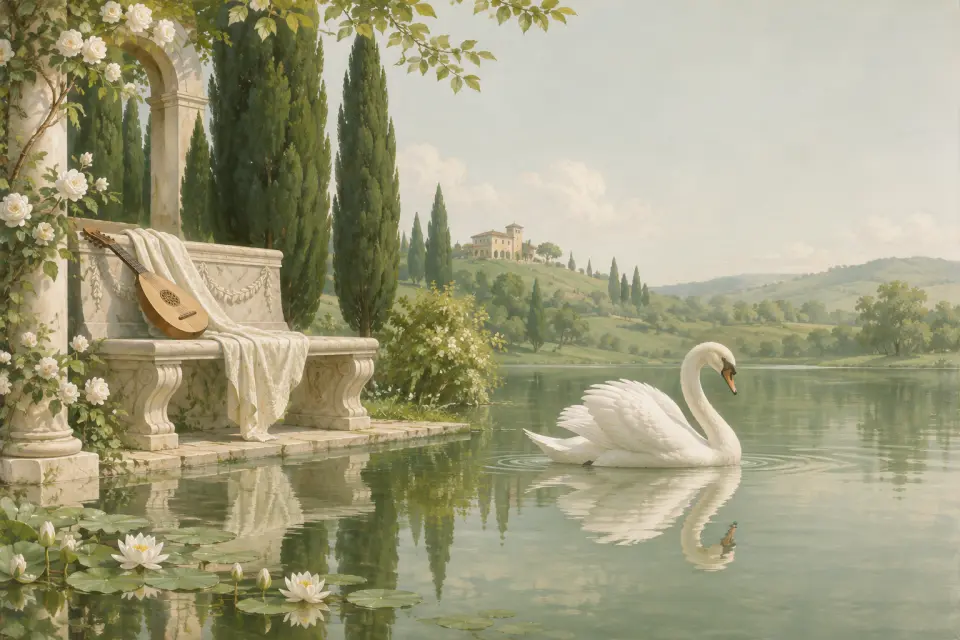
Giovanni Guidiccioni, another poet he set, supplied the words of his best-known piece, the four-voice madrigal Il bianco e dolce cigno (The white and gentle swan), which proved one of the sixteenth century's most lasting works. The piece opened one of Gardano's books and, already famous, was its main selling point. His madrigals are tuneful and plain in structure, singable, with a clear and generally fully diatonic harmony; unlike later madrigalists, he did not count on professional singers alone as his audience, for anyone able to read notes could sing them. Music meant for anyone who could read notes suggests an aim of sharing the madrigal with amateurs and not only with experts, which could help account for why this piece spread so widely.
His 1557 book of masses carries a dedication to Charles de Guise, Cardinal of Lorraine, his new employer, for whom he worked as maître de chapelle, or choirmaster. Paul III's death in 1549 left him in search of a post; he recalled the Cardinal's invitation and joined his household in 1551 or 1552, and from then on he gave more attention to the chanson. In the preface to Le Roy and Ballard's Livre de meslanges of 1560, the poet Pierre de Ronsard called Arcadelt "the most illustrious composer of the day, his music equaled that of the ancients through the inspiration afforded by his Apollo." A move from Rome to a cardinal's court in France and a poet's praise in print suggest a reputation that crossed borders in his own lifetime.
Buscar en la biblioteca